We recommend you
wear clothes that
dry easily and water
shoes
or footwear that is
secure and you don't
mind if they get wet.
Sunscreen
Hat
Towels
Water & bowl for
your dog
Treats
Water & Snack for
yourself
Leash
If you wear glasses you may want
to bring your spare glasses to
use or put
croakies on your
glasses to keep them from
falling in the water. ( they
can't swim ).
You may also wish to bring a
disposable water camera,
though
we usually have a camera with
us.
FOR
YOUR DOG'S SAFETY YOU MUST BE
FAMILIAR
WITH KAYAKING PRIOR TO KAYAKING
WITH YOUR DOG.
ADJUST YOUR EQUIPMENT:
Take time to properly adjust the
kayak seat & foot pegs before
you leave shore,
we will help you with
adjustments.
You paddle has a correct way to
be held. We will instruct
you on how to orient your
paddle, remember to check for
proper orientation when you are
paddling.
THE
FIRST STEP:
For most dogs we will get you
settled into the kayak, then
have your dog get into the kayak
with you. When you are both
settled we will shove you kayak
out onto the pond. It is
recommend that you just drift
for awhile while your dog gets
used to being in the boat.
This allows you to hold
them, pet them and talk to them.
In a few minutes you will be
able to start paddling.
Some
dogs love the water sooo much
all they want to do is swim.
Occasionally we will have an
owner paddle from shore and let
their dog swim after them.
They paddle out a ways and back
tiring the dog out a little,
then they can come to shore and
load the dog into the kayak with
them.
WHEN PADDLING,
STAY AWAY FROM SHORE: When you are kayaking with
your dog do not kayak near the
shore as it increases the
likelihood that your dog might
choose to leave the kayak and
swim to shore.
WHEN PADDLING,
STAY AWAY
FROM PEOPLE FISHING FROM SHORE: In order
to be "good neighbors" we keep
out kayaks away from the
fisherman. To keep you dog
safe from fishing lines and
hooks, keep your kayak and dogs away from
the fisherman.
STAY AWAY FROM OTHER BOATS: Keeping a safe distance from
other kayaks will help keep your
dog's attention on you.
Paddling near other dogs causes
arousal that could result in an
unexpected swim. Stay away from other boats
especially fisherman.
STAY CLEAR OF WEEDS AND DEBRIS:
Stay out of the weedy areas of
the pond. This would not be a
fun place for your kayak to tip.
AVOID CAPSIZING BY GETTING YOUR
DOG OUT OF THE BOAT: If your dog is rocking the
boat and you are unable to
secure them, toss them out of
the boat. It is better
that they are in the water, than
having both of you in the water.
AVOID CAPSIZING BY LETTING YOUR
DOG SWIM: If
your dog tries to get out of the
boat and you are having a lot of
trouble stopping them, let them
get out and swim.
SECURE VALUABLE ITEMS:
secure items in the boat,
leave valuable items at home or
in your car. ( we can lock
keys in our vehicle)
SECURE DOGS WHO MIGHT RUN OFF:
Some dogs may need a
floating rope attached to them.
This applies to dogs that are
known
to run off. ( let us know)
HOW
SHOULD YOUR DOG RIDE IN THE
BOAT: Most dogs like
to sit facing forward, some
prefer to sit facing you.
Either is doable, but there are
advantages to having your dog
sit facing forward. If
your dog is sitting forward you
can learn to hold them in a
sitting position with your
knees. Dogs should be
discouraged from bow riding
unless they are very small. Some
dogs will lie down and enjoy the
ride.
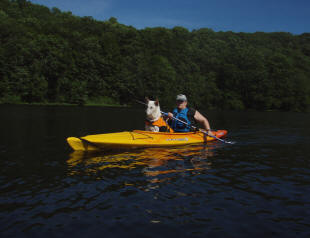
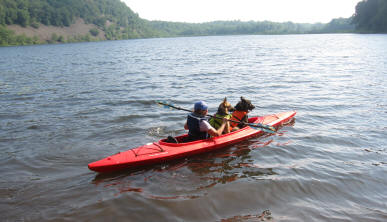
dog sitting facing
forward
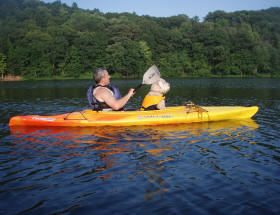
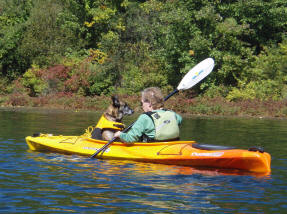
dog sitting facing
the owner
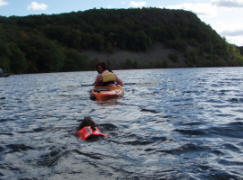
MANAGING YOUR SWIMMING DOG:
When your dog is swimming around
your kayak there are many things
to consider.
Don't paddle away from them too
fast as they will either panic
and try to catch you swimming
harder than they should
or they
may abandon you and swim towards
shore.
Don't let the dog catch
the back of the kayak, they will
try to climb onto the back.
Keep a distance of about 30
feet adjusting to your dogs
personality.
Some dogs are very relaxed in
the water and will readily swim
along side your kayak. If
the dog is swimming parallel to
you they can swim near the
kayak. They will learn to
stay away from your paddle.
If your dog is swimming at
you ( not parallel, then you
need to move ahead of them until
you are ready to bring them in
the boat.
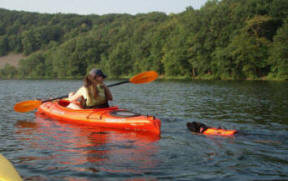
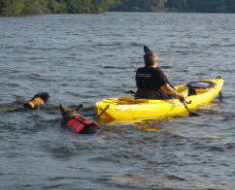
Good example of
watching the dog
following the kayak,
keeping an
appropriate
distance.
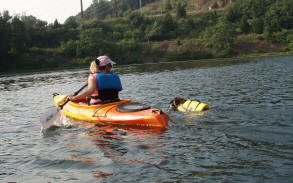
Good example
parallel swimming,
notice the dog is
going forward not
towards the kayak.
ALWAYS WATCH YOUR DOG WHEN THEY
ARE SWIMMING.
FOR YOUR DOG'S SAFETY IT IS A
GOOD IDEA TO HAVE ONE OF OUR
INSTRUCTORS FOLLOW YOU & YOUR
DOG THE FIRST TIME YOUR DOG IS
SWIMMING BEHIND YOUR KAYAK.
Getting your dog back into the
kayak
1. Turn your kayak to get
your dog coming perpendicular to
the kayak on your strong side.
This is the side you will be pulling
the dog into the kayak from.
2. When you are ready to pull
your dog into the kayak, place your paddle in the
water on the opposite side of
the boat. ( don't worry it
floats and it's on a leash )
3.
Take your time, your dog is
wearing a
lifejacket, he is fine.
Even if he looks a little wild
or panicked... take your time.
4. Get the dog at the side of
your kayak even with your
lap ( not behind you )
5. Turn the dog perpendicular to
the boat and encourage them to
put their feet on the side of
the kayak. Lean slightly towards
the dog to lower the kayak side.
The dog's PFD has a handle on it
to help you pull them into the
kayak.
6. Pull the dog towards you. As the dogs feet come up
on to the kayak, lean away from
the dog as you pull them into
the boat. (don't over lean)
As
soon as the dogs front feet are
in the kayak center yourself and
help the dog get his rear legs
in and turn around and
sit.
7. If you don't think
you can get your dog into the boat
safely,
don't try it yourself, paddle
away from your dog ( he will
swim behind you) and we will
come help you.
Kayaking with more than one dog.
After each of your dogs have
mastered kayaking individually,
then they can learn to kayak
with you together. You
must be sure that the kayak's
weight capacity is sufficient to
accommodate the weight of both
you & your dogs.
A. We recommend that people who
are not familiar with kayaking take one
kayaking session without their dog to learn
how to paddle and turn the boat prior to
kayaking with your dog. Your dog's
safety depends on your ability to manage the
kayak.
Q. How much kayaking experience do I
need?
A. You should be comfortable
paddling the kayak and have the ability to
change directions quickly. This is
necessary in the event the dog leaves the
kayak and you have to go get him.
Q. My husband and I would like to do
this together do we each have to have a dog?
A. You may reserve 2 kayaks even
if you only have one dog. ( you may also
reserve 2 kayaks for 2 dogs )
Q. My dog hates the water I don't think
we can kayak.
A. If your dog hates the water he
will probably stay in the boat, making
kayaking a little easier
Q. My dog loves the water I don't think
he will stay in a boat.
A. Most dogs will stay in the
kayak, if yours won't your dog can swim
beside the kayak until he becomes tired,
then he can learn to ride in the boat.
Q. I am worried because my dog
can't swim
A. We have life jackets that will
fit your dog
Q. Do I have to wear a life jacket I am
a good swimmer
A. Yes, we require life jackets.
Q. Can't I just come with my kayak ?
A. We have a fleet of kayaks that are
particularly stable and well suited to
kayaking with dogs. Not all kayaks are
stable enough to kayak with a dog.
Q. Can you teach my dog to swim ?
A. The three lessons we focus on
are...
Lesson 1: Teaching your dog to ride in the
kayak with you .
Lesson two: teaching your dog to swim beside
the kayak.
Lesson three: teaching you how to get
the dog in and out of the kayak.
Sometimes we can achieve these lessons in
one session, sometimes it may take 2 or 3
sessions. It is best to let the dog
learn as they are ready
Q. I'd like to kayak with both of my
dogs
A. We can allow this if both dogs
have kayaked and have acceptable skills and
fall within kayaks weight limits.
The Smartydog Center for Canine Enrichment
312 East Johnson Avenue Cheshire, CT 06410
( 2 miles from I-691)
203.272.2182
Martha T Bailey CKO CBS 40+ years experience for you & your dog